
Author: Richard Ablitt
MTh in Reformed Theology student (UTC)
I was privileged to attend a Summer School hosted by the Theological Faculty of the University of Zurich between 15–20 June 2025 to celebrate the Quincentenary of the founding of the Zurich Academy, or Prophezai.
Huldrych Zwingli began evangelical preaching at the start of 1519 in the Grossmünster church using the Lectio Continua method, beginning with Matt. 1:1. It was his conviction that the Holy Spirit would employ learned exposition to make scripture come alive to the hearers, so that it would indeed become afresh the voice of God, hence ‘prophesy’ was a fitting term. He attracted a community of linguistic and other scholars to engage in the task. On 19 June 1525, supported by the City Council, the Academy or Prophezai was formally established. This was the first Reformed academy anywhere, and it provided a model that was followed and adapted elsewhere. It still exists as the Faculty of Theology and Religious Studies of the University of Zurich, formed out of the Academy in 1833. After a period on the university campus, it returned to the Grossmünster, now occupying three floors over the abutting cloisters.
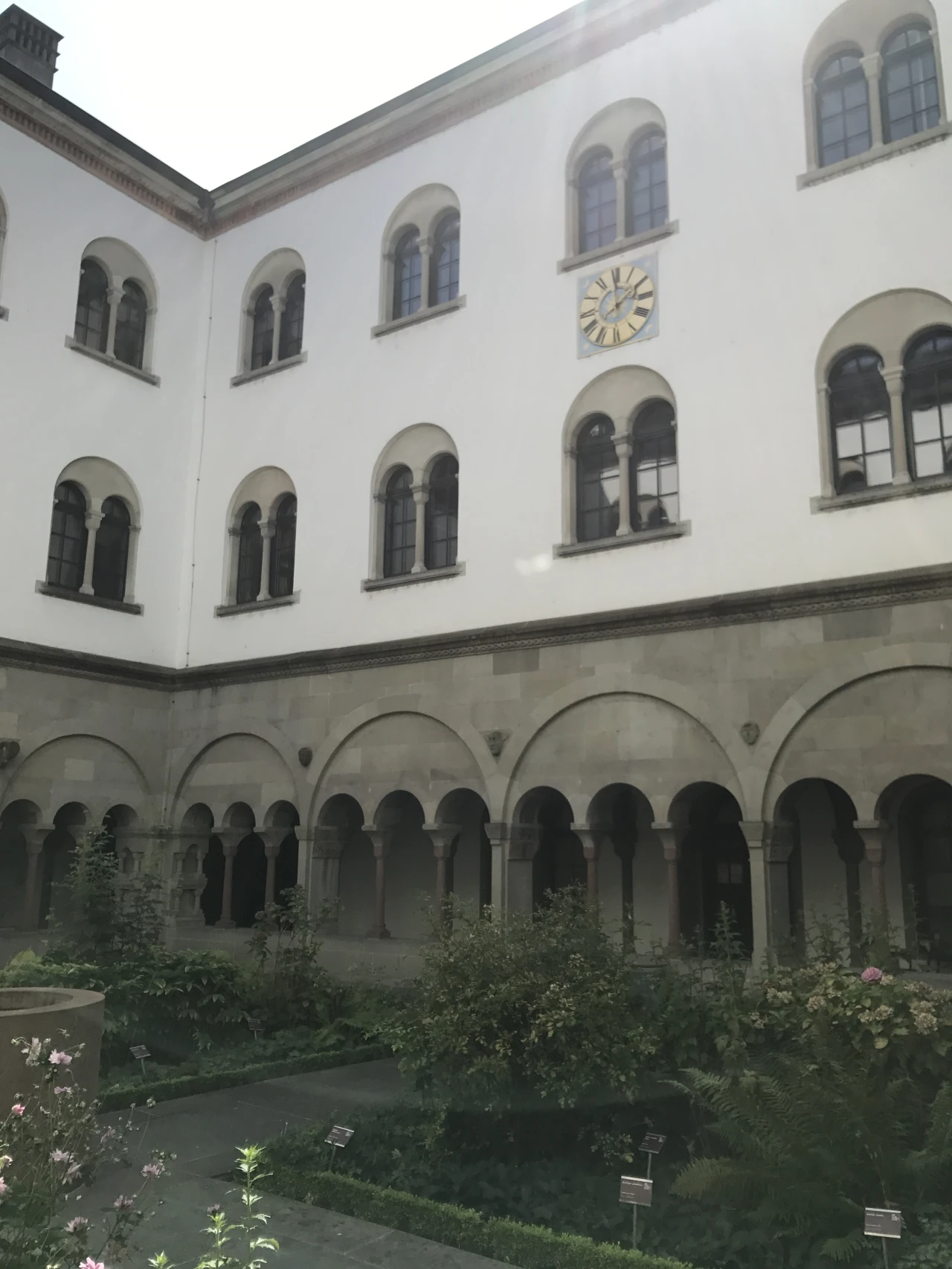
We worked hard. Each day consisted of two four-hour sessions, the normal pattern being a lecture, after which we broke into discussion groups (often enjoying the relative cool of the cloisters), returning for feedback at the end. The attractive cloister gardens were redesigned in 2009 taking inspiration from the work of the renowned Zurich polymath and early botanist Conrad Gessner (1516–1565), a friend of both Zwingli and Bullinger.
The work of the Institute for the History of the Swiss Reformation within the Theology Faculty continues. Along a corridor, one finds a photocopy of a sentence from a letter in Bullinger’s handwriting: students’ suggestions on how to decipher are invited! The digitalisation of his vast archived correspondence is an ongoing project (https://bullinger-digital.ch).
The first lecture by Tobias Jammerthal (Zurich), gave a historical introduction covering the development of the Prophezai out of the pre-existing monastery school. In the afternoon Stefan Krauter, also of Zurich, introduced the topic of biblical exegesis in Switzerland in the sixteenth century using the example of the Pauline epistles. We enjoyed the hospitality of an aperitif/light supper in the cloisters in the early evening following this.
On Tuesday morning Moritz F. Adam (Zurich), who has an Oxford background) spoke on the relationship between Switzerland, England and Scotland in the early Reformation period in relation to church history and exegesis. In the afternoon Bruce Gordon (Yale) lectured in German on the Biblia Tigurana (the German-Swiss translation of the whole Bible published in 1531) and the central results of the work of the Prophezai.
On Wednesday morning Mathias Schmoeckel of Bonn spoke about the Reformed authorities from Zurich to Norway. This broadened our considerations both geographically and also topically by introducing the subject of legal relationships and jurisprudential developments in the Reformation period and opened up questions about the interrelationships of theology and law during this period; this particularly interested me as a practising lawyer.
In the afternoon we enjoyed a boat trip round Lake Zurich and then took a bus into the hills to visit the Kappel monastery building. In 1523 the 18-year-old Heinrich Bullinger was interviewed for a job as schoolmaster there by Abbot Joner. Famously, he agreed to accept the position only if, firstly, he did not have to take monastic orders, and, secondly, he would teach the scriptures. Joner agreed. As a Bullinger researcher it was fascinating to be shown by our tour guide the reception room where he believes these conversations took place. (It is now a wine cellar, “only good wine” I was assured.) Bullinger’s vernacular lectures on the Bible were open to the whole village, and soon also attracted hearers from the Catholic region of Zug, involving a lengthy walk and the risk of a fine. Following the monastery’s reformation and the monks’ voluntary vote to dissolve, Bullinger was installed as preacher. The pulpit still bears faintly etched on the plinth its construction year, 1527. A short worship service following a simple liturgy was included, and a lovely open-air meal was provided in the evening, food locally produced, including from the monastic gardens which are still maintained.
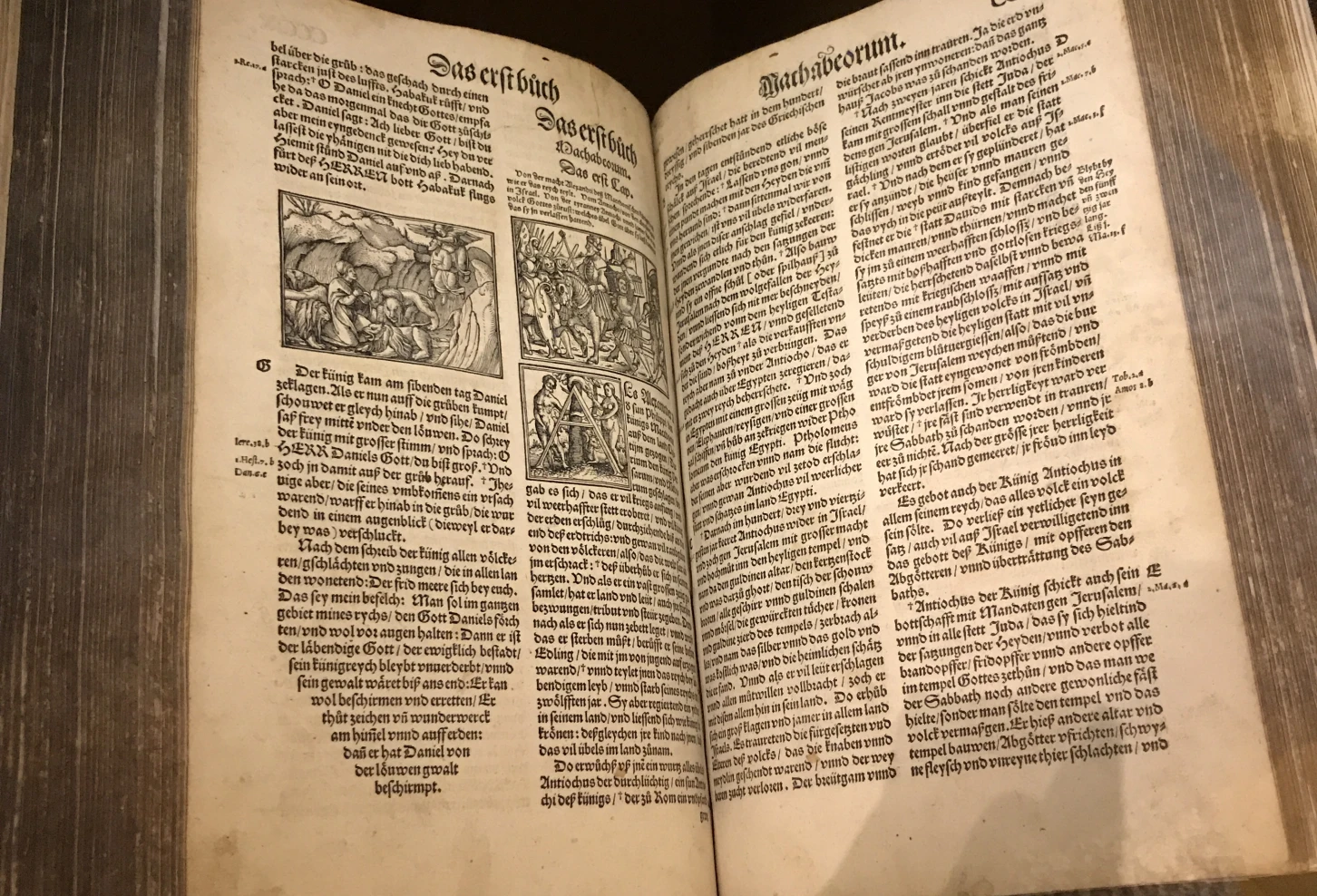
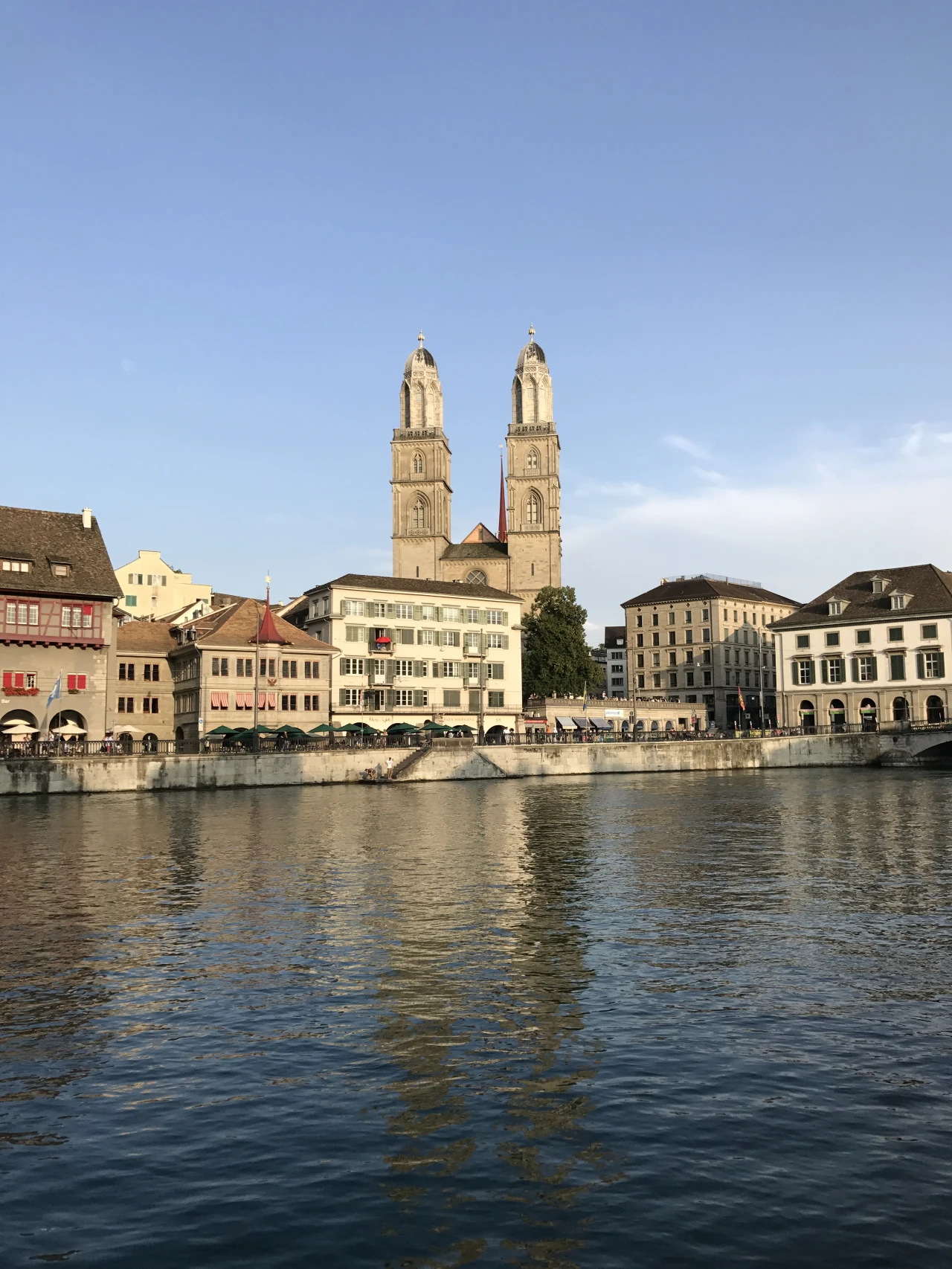
On Thursday morning Stefan Kautner, Professor of New Testament at the University spoke on aspects of exegetical-historical research from the perspective of New Testament exegesis, looking at Romans commentaries of Erasmus, Zwingli and Bullinger. During lunch I explored the Grossmünster. It is a very well preserved large Romanesque city church. Climbing one of its twin towers which are a distinctive feature of the Zurich cityscape provides an excellent view across the River Limmat to the Fraumünster Church opposite. The gallery contains a small Reformation library collection, including one of only three surviving first editions of the Zurich Bible (or Froschauer Bible, after its printer) and Bullinger’s personal Bible which is a second edition. Both are in excellent condition. A feature of these Bibles are their beautiful colour illustrations, by Holbein the Younger, and their copious marginal notes. A display note mentions that the anti-Anabaptist notes in the first edition were edited out of the second. One wonders if this reflects Bullinger’s influence, and his more irenic temperament than Zwingli, and also that the Anabaptist controversies had been successfully concluded, in Zurich at least. In the afternoon Volker Leppin (Yale), delivered a masterly presentation (online from his congested study) on printed German scripture texts in German lands during the fifteenth century. From my perspective the availability of these texts showed a vast contrast to the situation in England. It would be interesting to explore the significance of this in why the Reformation began in German speaking lands before England. There was a reception on the University campus that evening to mark the quincentenary.
On Friday morning Dr Alex Ryrie (Durham) delivered a fascinating lecture on Protestant Missionary Translations in the seventeenth and early eighteenth centuries and the application of Reformatory ideas in global mission. We looked at some texts emanating from New England Colonies. Those interested in David Brainard will find interesting new work here. Brainard employed a native American interpreter who had previously been engaged by Count Zinzendorf, and Dr Ryrie presents him as a hitherto invisible but significant figure in the development of Brainard’s evangelistic approach. For further information consult his forthcoming book: The World’s Reformation: How Protestantism became a Global Religion.
Finally, Prof Conrad Schmidt (Zurich) gave a history of the Faculty of Theology from 1833 to the present. I was interested to learn if and how the original Geist of the Prophezai continues. The Faculty is non-confessional and allows different approaches, although it rejected the more radical 19th century teachings of Strauss and Bauer. It seeks to remain Swiss while also international, maintaining a roughly 50-50 staff ratio in this regard. It maintains a close relationship with the Reformed church and many of its professors have also been active pastors. An example is Emil Brunner’s wartime sermons on the Creed delivered from the Fraumünster pulpit (available on Internet Archive). The Faculty has had renowned professors, but Dr Schmidt wished to emphasise the continuity of the community (his grandfather also held a theology professorship). My impression is that the Faculty has a strong emphasis on careful study of original texts and their contexts and in this respects is high calibre.
We were a group of about thirty, Zurich students and visitors. The Prophezai embodied a local movement with a global vision, so it is fitting that, for example, we had three Chinese participants. We worked tremendously hard to help each other, and I hope this itself is a fitting small tribute to the quincentenary of a movement that continues to this day. Thanks are due to Dr Jammerthal for working late each night to produce detailed and insightful summaries of the past day’s proceedings.
I was accommodated as guest of one of two community houses for theological students associated with a suburban Reformed church. I was encouraged by the commitment shown both in their lives and their studies. The week left a deep impression on me.