
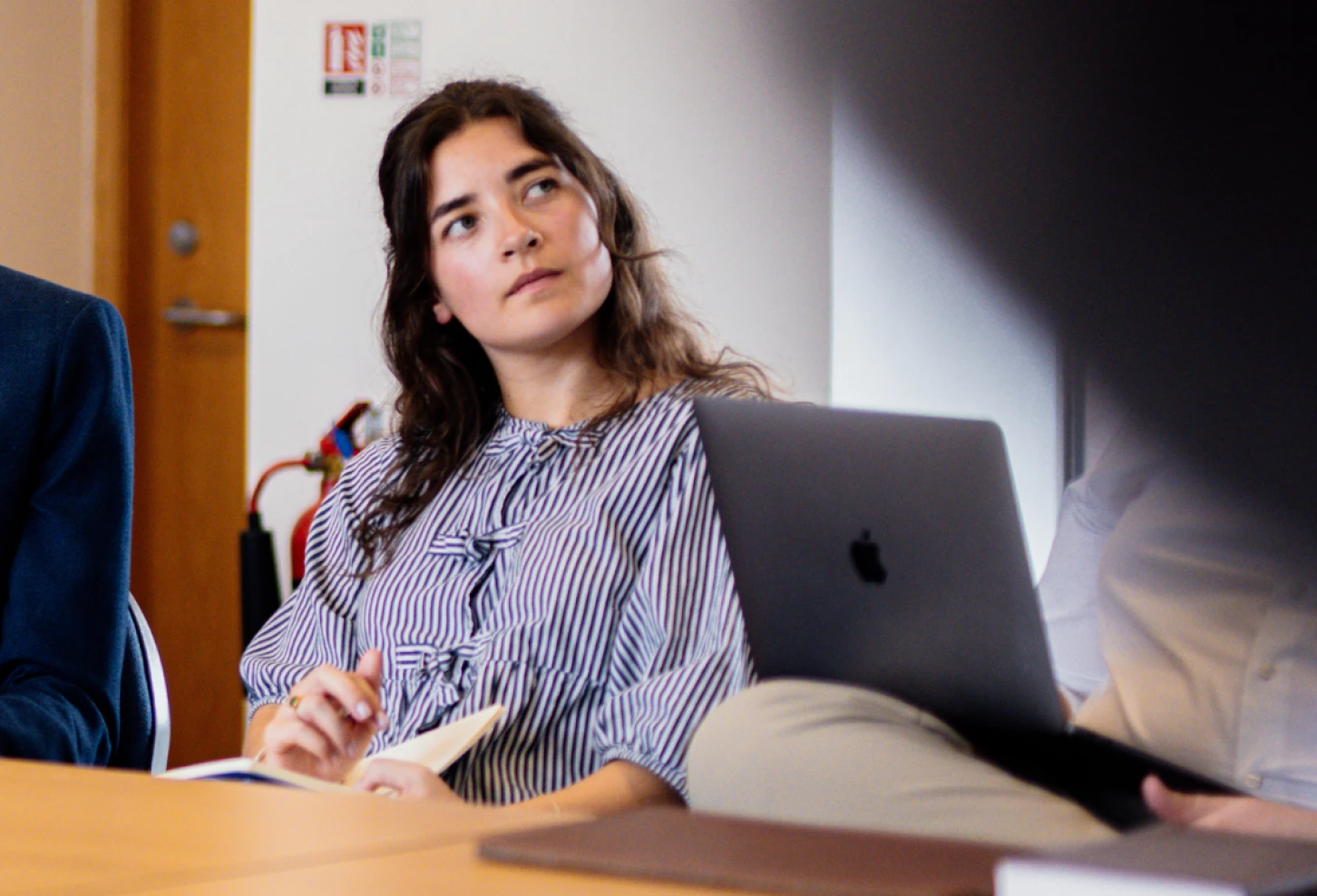
What is your area of research at UTC?
My PhD continues looks at musical imagery in Lewis’s literature, and I’m excited to be able to focus more on the theological significance of these metaphors (supervised by Professor Michael McClenahan and Professor John Gillespie).
My current research has grown out of earlier interest in this topic. I wrote an essay on musical metaphor in C.S. Lewis’s The Magician’s Nephew as part of a final year Music Theology module at Durham University. I discovered this was an interesting area and also identified it as a gap in scholarly literature - not much had been written on C.S. Lewis and music. I then went on to study an MPhil in Music at the University of Cambridge; the highlight of my Masters was working on my research dissertation with Professor Jeremy Begbie. My project looked at the musical imagination of C.S. Lewis and considered the theological significance of music in his life and literature. I soon found that 15,000 words was not enough to cover this rich topic! It was great to be involved with the C.S. Lewis Society in Magdalene College, Cambridge as both a member and speaker during my degree there.
How did you find out about the PhD programme at UTC?
After my Masters I worked for a year at the Round Church in Cambridge with The Foundations Trust. This job incorporated lots of involvement with different ministries, but as part of it I gave C.S. Lewis walking tours of Cambridge, and organised musical events in the city, including a celebration of the 75th anniversary of The Lion, the Witch and the Wardrobe. This year really helped me to discover that I did in fact want to pursue further studies - I missed having the time to dedicate to researching and writing!
I was excited then when the opportunity came up to speak at a C.S. Lewis conference in Belfast. I booked in some annual leave so that I could come back to Northern Ireland and attend and share at the conference. I really enjoyed preparing for this and delivering my paper. The Revd Dr Malcolm Guite was a keynote speaker. He sat in on my paper and was particularly encouraging in his words afterwards (and referenced my work in his article). I found this conference really rejuvenating, and a helpful affirmation that I did want to seriously look into the potential of further studies.
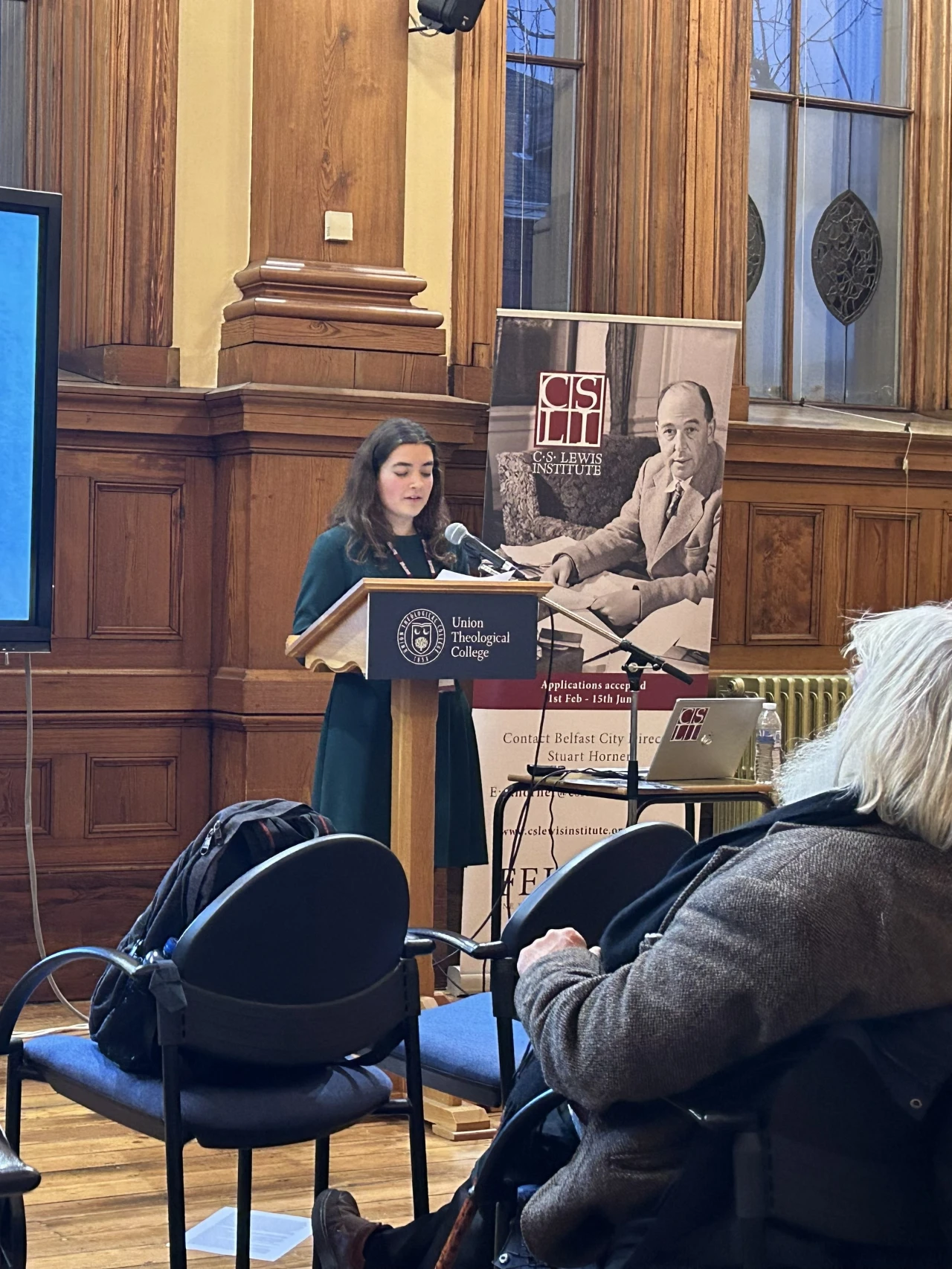
Sophie presenting her paper at the CSLI Conference
At the start of the conference, Professor McClenahan welcomed us to the College and made an announcement about postgraduate studies at UTC. As I was considering various options, I looked into the possibility of UTC once I returned to Cambridge in November. I then met with Michael that December at UTC when I was home for Christmas, to speak about the potential of doctoral studies on my topic at Union. We had a really encouraging conversation, and I left feeling excited by the project.
After Christmas I continued putting together a research proposal and submitted my PhD application for UTC in February. Waking up every morning before work in Cambridge to work on my research proposal became an enjoyable part of my routine. I realised that the prospect of studying this fulltime was a really exciting one for me (which I took as a good sign). It became clear that UTC would be a great place for such study. I’m grateful to be able to study this interdisciplinary project on C.S. Lewis at UTC, in his own homeland!
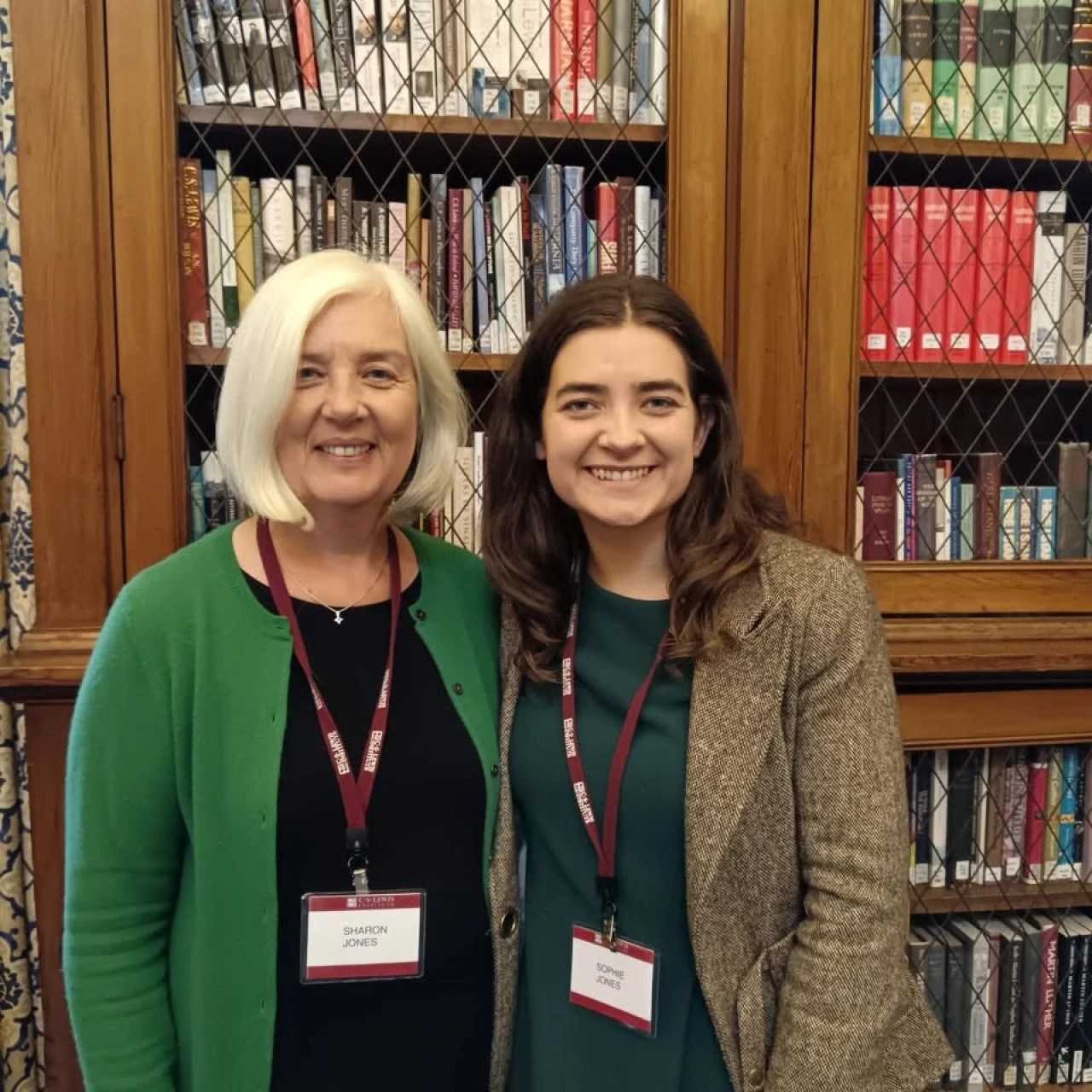
Both Sophie, and her mum, Dr Sharon Jones, presented papers at the CSLI conference in November 2024.
Can you tell us about the research you presented at the CS Lewis Institute Belfast’s 2024 conference at UTC?
I delivered a paper at the 2024 conference (hosted at UTC) on musical imagery in C.S. Lewis’s The Screwtape Letters. This was my first time presenting at an academic conference, and I was able to share some of my MPhil research. This was also my first introduction to UTC. I had walked past the college for years on my walk from school (Methody) to Botanic train station but had never stepped inside! I arrived at the college on 4 November 2024, nervous to present my first ever conference paper…little did I know that I was also embarking on a new and exciting journey. A year and a half later I’m really enjoying my first year of doctoral studies at UTC. Since my first conference I have presented at the Oxford C.S. Lewis Society (November 2025) and will soon be speaking at two more upcoming academic conferences.
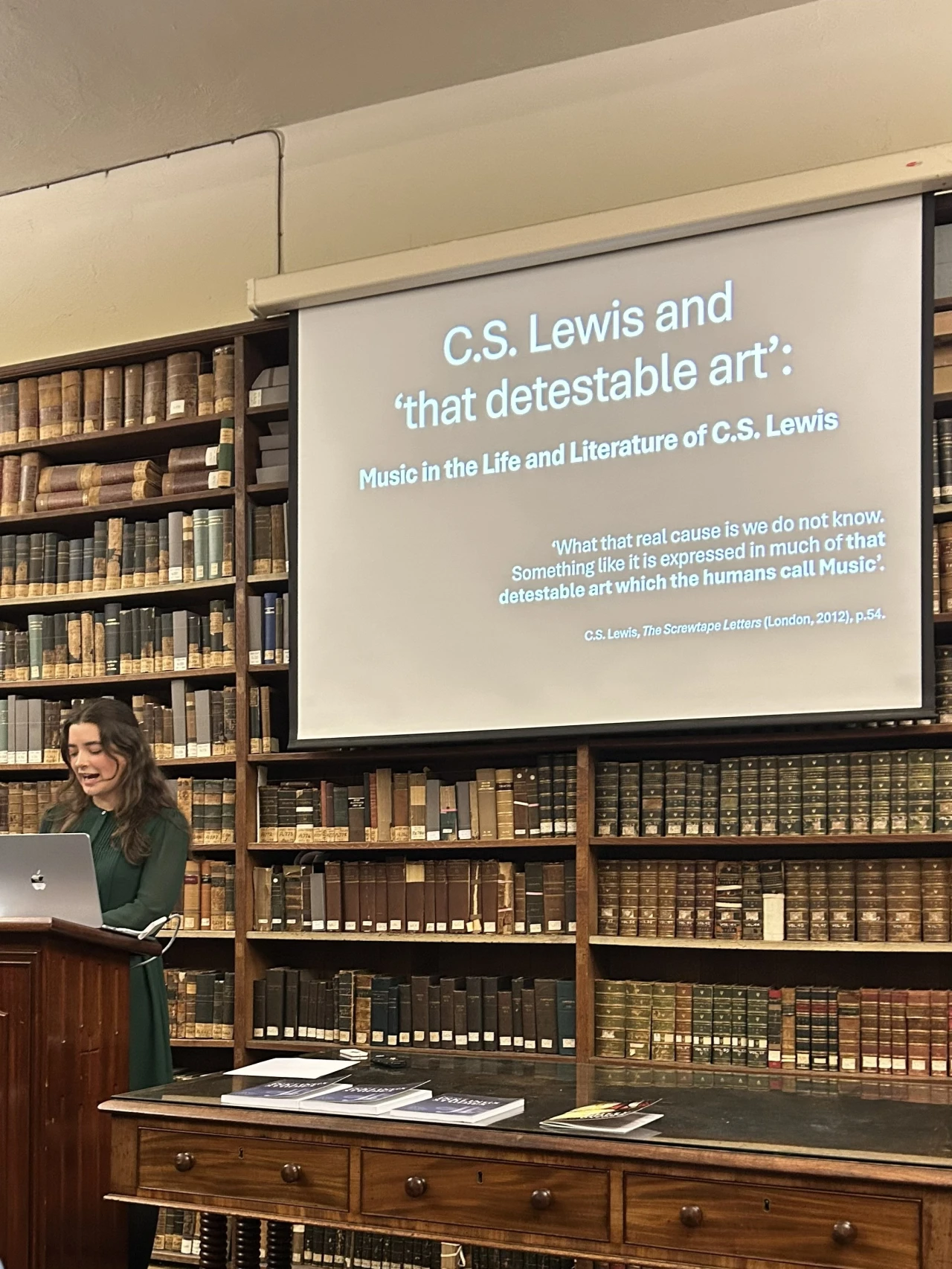
Sophie at the Oxford C.S. Lewis Society
Can you tell us about what drew you to music in Lewis’s writings as a research topic?
I have always loved music, and spent most mornings, lunchtimes, and afternoons in Methody at choir, band, and orchestra rehearsals. In my final few years at school, I achieved Diplomas in Jazz and Classical Saxophone, and Grade 8 Violin and Piano. Around this time in a careers meeting, a teacher told me that Durham University allowed you to submit a second personal statement, which would enable me to apply for a different subject (this worked well for my indecision!). I remember thinking it would be fun to write a random statement for music given it was something I enjoyed, so I ended up applying to Durham University for Music.
I then went on to study an MPhil in Music at the University of Cambridge. I was grateful to be able to study modules in Musicology (with the Music Faculty) as well as in Philosophy of Religion with the University of Cambridge Faculty of Divinity. I had some excellent musical opportunities: singing with the Magdalene College Cambridge Chapel Choir and St Edmund’s College Cambridge Chapel Schola, receiving saxophone lessons in London with Kyle Horch (Royal College of Music), and being awarded the Trinity Hall Instrumentalist Award, which included giving a saxophone recital in my college. The highlight of my Masters was working on my research dissertation with Professor Jeremy Begbie. My project looked at the musical imagination of C.S. Lewis and considered the theological significance of music in his life and literature. It was great to be involved with the C.S. Lewis Society in Magdalene College, Cambridge as both a member and speaker during my degree there.
My research, focusing on musical imagery in C.S. Lewis’s literature, is very interdisciplinary in nature, drawing on Theology, Music, and English! Whilst at Cambridge this meant walking between the various libraries for each of these three disciplines. And now at Union I love spending time in the Gamble library with the extensive selection of Lewis and theology resources, and also the McClay Library next-door for more English/Music resources. The more I explore the interplay between music and theology, the more I’m drawn to this field. Thanks to New Irish Arts and supportive church environments, I have been encouraged from a young age to consider how my faith and music go hand-in-hand: bringing them together feels very natural to me. And so, discovering this interplay within academia was a great joy. I continue to love engaging with the growing field of theology and the arts. It was really the discovery of the interdisciplinary study of music and theology that led me to considering studying my masters, and subsequently the PhD. I hadn’t thought of further study until I came across this field, and now I’m very glad I was introduced to it as it’s what I spend my days thinking about! I have been a member of the organising committee for the International Network for Music Theology conferences for two years. I think there is a rich interplay between music and theology more broadly, and I’m excited to continue working in this area especially in my work on Lewis.
You’ve been involved in the Scriptorium meetings at UTC this year. Can you tell us about the purpose of that group?
This year there has been a new postgraduate study group in Belfast, which I’ve been involved in and has kindly been physically hosted by UTC. Scriptorium is for students of all faiths and none across Belfast, and we’ve been meeting once a week in UTC. I describe Scriptorium as a co-working space for postgrad students – we come together for times of private study interspersed with coffee/tea/lunch breaks. The study day is structured by rhythms of prayer and rest. Because postgraduate research can be isolated and lonely, this is an encouraging and rejuvenating space. Those of us who attend find that coming together in this way helps to spur one another on. We enjoy toasties at lunchtime, as well as the fellowship this time facilitates – this has created space for fun conversations getting to know each other, as well as for learning from one another and our various approaches to postgraduate studies. Scriptorium aims to foster community and a productive space for postgraduate students in Belfast. This year we have had postgrad students involved from various institutions: UTC, QUB and Stranmillis College.
And finally, how would you describe your experience at UTC so far? Any particular highlights?
I remember when I first met with Professor McClenahan about doing a PhD at UTC he emphasised that UTC was a unique and special place because of its community. Studying as a humanities postgraduate can be quite isolated, so I’m very thankful that my experience at UTC has been one surrounded by a supportive community. The weekly worship services in college are great - coming together with the whole college and centring our minds on Christ and remembering the motivation for our study! I’ve enjoyed getting involved with music in college life too – serving alongside others from the college community in weekly services, and at Christmas putting together a choir for the college advent carol service. This was another good way to get to know people in college, as well as combining some of my interests!
Especially at the start of the year, I really appreciated the daily coffee times for getting to know people in college – there is such a unique mix of people from undergraduate, to postgraduate, to ministry students, to faculty and staff. Right from September this year I have experienced a warm welcome to college life. It has been wonderful getting to know everyone this year so far and I’m looking forward a few more years of that!
I have found the faculty and staff at UTC so supportive. Everyone is very generous with their time and attitude and I don’t take that for granted! It makes such a difference to my studies to be in this environment and I think it’s one of the reasons that UTC is a good place to be. I am thankful to be able to learn from everyone’s expertise and to enjoy stimulating conversations. I also value that people are keen to share and support development opportunities. Most recently I really valued the UTC PhD symposium, May 2026. It was encouraging to hear from other PhD students, and I particularly enjoyed Dr Kevin Vanhoozer’s plenary paper – I think I will find myself often returning to the wisdom he shared in this talk!
If you’re interested in pursuing PhD research with UTC, contact Dr Martyn Cowan, Director of Research, at mc.cowan@union.ac.uk